
People with cancer often get treatment through a vein. The medical term for this is intravenous (IV) treatment. Your health care team can give you chemotherapy, other drugs, blood transfusions, and fluids this way. Medical devices called catheters and ports make intravenous treatments easier. They can also make it easier for your health care team to take blood samples.
What are catheters and ports?
A catheter is a thin tube made of soft plastic that goes inside a vein. Your health care team uses the catheter to give treatment through that vein.
A portion of the catheter may stay outside your body so it is easy to insert the medication into the catheter. When you are not getting treatment, the catheter is clamped or capped to keep it closed. Some catheters split into 2 or 3 separate ends. These are double lumen or triple lumen catheters. This type of catheter allows you to receive more than 1 treatment at a time.
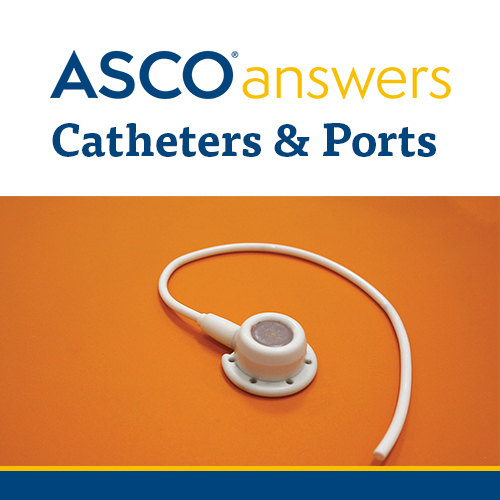
Sometimes, a catheter gets put completely under the skin. If so, it connects to a small plastic or metal disc called a port. A port also goes under the skin. You might see or feel a small lump at the side of the port. But you will not see the tip of the catheter.
What are the types of catheters used in cancer treatment?
There are many types of catheters. They work in similar ways. Which one you have depends on factors such as:
-
How long you need cancer treatment
-
Your type of treatment
-
How easy it is to care for the catheter
-
The cost of the catheter and its insertion
Where and how the catheter is put in your body depends on the type of catheter. The different types of catheters are:
IV catheter. Treatments that are given in a vein are often given through a catheter with a small needle. This is called an IV catheter or simply an "IV." Your nurse puts the needle in your forearm or the top of your hand. Besides chemotherapy, you can get other drugs this way. For example, you might get medication that helps with nausea in your IV.
A nurse usually takes out the IV catheter when the day's treatment ends. You get a new IV each time you have treatment. Sometimes the catheter can stay in for 2 or 3 days if it is safely in your vein and not painful.
Peripherally inserted central catheter (PICC). This is usually called a PICC ("pick") line. A nurse or doctor with special training puts it in a large vein near your elbow. They will use a local anesthetic to numb the skin and tissue when the PICC line is inserted. An anesthetic is medicine that blocks the awareness of pain. Once the tip of the catheter is in the vein, a few more inches of the catheter go into the vein. This is to ensure the catheter does not come out. The last part of the catheter is left outside the body at the place where the catheter was inserted.
Central line, tunneled venous catheter, or Hickman catheter. A health care professional with special training puts this catheter in a large vein under your collarbone. Or it might go into a neck vein. Like with the PICC line, the tip of the catheter goes into the vein and a few inches of the tube goes into your body. The remainder of the catheter tube will remain outside the body at the chest or neck. You will receive a local anesthetic or conscious sedation when the catheter is put in. Conscious sedation is medication to help you relax and feel sleepy.
Implantable port or port-a-cath. A surgeon or radiologist puts in a port. This is usually done with local anesthesia or conscious sedation. The entire catheter goes under the skin of your chest or upper arm. To give treatment with a port, your nurse may first numb the skin with cream. Then, your nurse cleans the skin and puts a needle into the port. Treatment or blood samples go through the needle.
What are the benefits of catheters for cancer treatment?
A catheter in the upper arm or neck can stay in place for weeks or months. Your health care team can use it to:
-
Reduce the number of times a nurse or other team member needs to insert a needle into your vein to give treatment or take a blood sample for testing. Health care team members call this a needle stick. The catheter helps if you would need a lot of needle sticks, have small or damaged veins, or are afraid of needles (trypanophobia).
-
Give blood transfusions or more than 1 treatment at a time.
-
Reduce the risk of drugs leaking outside a vein.
-
Avoid bruising or bleeding if you have bleeding problems such as a low platelet count.
-
Let you have some chemotherapy at home instead of the hospital or clinic, for certain treatment plans. You can get continuous infusion therapy this way. During this type of therapy, you receive treatment drugs through a small pump that you wear or carry.
What are the benefits of ports for cancer treatment?
Ports can remain in place for weeks, months, or years. Your team can use a port to:
-
Reduce the number of needle sticks.
-
Give treatments that last longer than 1 day. The needle can stay in the port for several days.
-
Give more than 1 medication at a time through a double port.
-
Do blood tests and give chemotherapy the same day with 1 needle stick.
What are the risks of using catheters and ports during cancer treatment?
Each catheter type can have side effects and risks. These include potential infections, blockages, and clots. Less common problems are a twist in the catheter under your skin or the catheter or port moving.
Relieving side effects is an important part of your overall cancer treatment. This type of care is called palliative care or supportive care. Talk with your health care team about the side effects you experience and ways to manage and treat them. This conversation should include what signs, symptoms, or problems you or your caregiver should report right away.
How do I care for my catheter or port?
Taking good care of your catheter or port reduces the risk of problems. It is particularly important to take special care of the portion of the catheter outside the skin and the area around it.
You must also flush a catheter with sterile fluid every day. This keeps it from being blocked. Your nurse will show you how or an IV service can help until you feel comfortable doing it. This may be shown at the doctor's office or during an at-home visit.
Your health care team will tell you how to take care of your catheter or port. Common instructions include:
-
Always wash your hands before you touch the catheter. This helps prevent infection.
-
Never touch the catheter tip when the cap is off.
-
Follow instructions on regularly cleaning the area and changing the bandage, while holding the catheter in place.
-
Keep air out of the catheter. Make sure the top or clamps are on tight except during treatment.
-
Avoid any breaks or cuts in the catheter.
-
Keep the catheter from going underwater.
A port is under your skin, so it needs less care. After the port is put in place, the skin will need to heal. Ask your health care team how to care for the area and follow their guidance. Sometimes, your port does not get used often. Your nurse may need to flush it so it does not get blocked.
When should I call my health care team?
Contact your health care team right away if:
-
The area around the catheter or port becomes red, swollen, painful, bruised, or warm.
-
Your arm on the same side as the catheter becomes swollen.
-
There is a lot of bleeding around the catheter or port.
-
You get a fever.
-
Any fluids leak out of the catheter.
-
You have shortness of breath or dizziness.
-
The catheter tube outside your body gets longer.
-
You cannot flush the catheter or port with liquid and it seems blocked. Never force fluid into the catheter.
-
You experience any symptoms or problems your cancer care team advised you that you should let them know about right away.
How are catheters and ports removed?
Your doctor or nurse will take out or your catheter or port when you no longer need it.
If you have a PICC line, the doctor or nurse will gently pull the tube until it feels loose. Then they will remove it. This does not usually hurt and you do not normally need anesthesia.
If you have a port or neck or chest catheter, your doctor or radiologist will make a small cut in the skin. Then they will gently remove the port or catheter. You may need local anesthesia or conscious sedation.
Questions to ask your health care team
-
Why do you recommend I get a catheter or port?
-
What type of catheter or port do I need?
-
What are the risks of this type of catheter or port? What problems should I tell you about right away?
-
Who should I call if I have problems with my catheter or port? What about after-hours?
-
What portion of the cost will my health insurance cover of putting this catheter or port in?
-
Will I feel any pain or discomfort when the catheter or port is put in?
-
How long does it take to put in a catheter or port?
-
How long will my catheter or port stay in?
-
How should I care for my catheter or port? How often?
-
Will I be able to see or feel the catheter or port?
-
How will a catheter or port affect my daily life? Will I be able to wear regular clothes, bathe, swim, and exercise?
-
Will a catheter or port cause problems with radiation therapy or scans?
Related Resources
What to Expect When Having Chemotherapy
American Society of Clinical Oncology Clinical Practice Guideline: Central Venous Catheter Care for the Patient With Cancer
 Download ASCO's free