
ON THIS PAGE: You will learn about how doctors describe a cancer’s growth or spread. This is called the stage. Use the menu to see other pages.
READ MORE BELOW:
-
Stage groups for papillary or follicular thyroid cancer in a person younger than 55
-
Stage groups for papillary or follicular thyroid cancer in a person 55 and older
What is cancer staging?
Staging is a way of describing where the cancer is located, if or where it has spread, and whether it is affecting other parts of the body.
Doctors use diagnostic tests to find out the cancer’s stage, so staging may not be complete until all of the tests are finished. Knowing the stage helps the doctor recommend the best kind of treatment, and it can help predict a patient's prognosis. There are different stage descriptions for different types of cancer.
This page provides detailed information about the system used to find the stage of thyroid cancer and the stage groups for thyroid cancer, such as stage II or stage IV.
TNM staging system
One tool that doctors use to describe the stage is the TNM system. Doctors use the results from diagnostic tests and scans to answer these questions:
-
Tumor (T): How large is the primary tumor? Where is it located?
-
Node (N): Has the tumor spread to the lymph nodes? If so, where and how many?
-
Metastasis (M): Has the cancer spread to other parts of the body? If so, where and how much?
The results are combined to determine the stage of cancer for each person. For thyroid cancer, there are 5 stages: stage 0 (zero) and stages I through IV (1 through 4). The stage provides a common way of describing the cancer, so doctors can work together to plan the best treatments.
In addition to the TNM system, papillary and follicular thyroid cancers are also staged based on the age of the patient.
Staging can be clinical or pathological. Clinical staging is based on the results of tests done before surgery, which may include physical examinations and imaging tests. Pathological staging is based on what is found during surgery, including a biopsy. In general, pathological staging provides the most information to determine a patient’s prognosis.
Here are more details on each part of the TNM system for thyroid cancer:
Tumor (T)
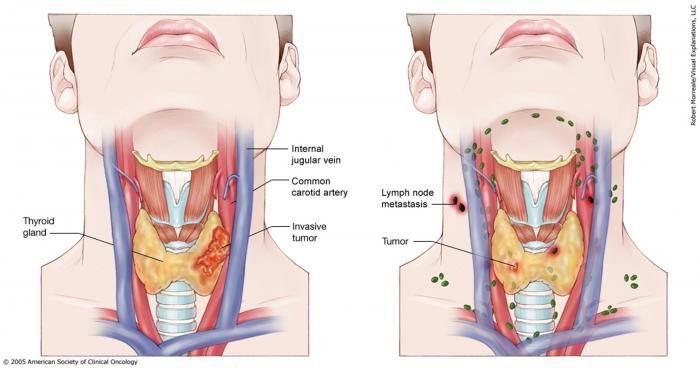
Using the TNM system, the letter “T” plus a letter or number (0 to 4) is used to describe the size and location of the tumor. Tumor size is measured in centimeters (cm).
Stages may also be divided into smaller groups that help describe the tumor in even more detail. When describing “T” in thyroid cancer, doctors may subdivide the general categories by adding the letter “s” to indicate a solitary (single) tumor or “m” to indicate multifocal (more than 1) tumors. Specific tumor stage information is listed below.
TX: The primary tumor cannot be evaluated.
T0 (T zero): There is no evidence of a tumor.
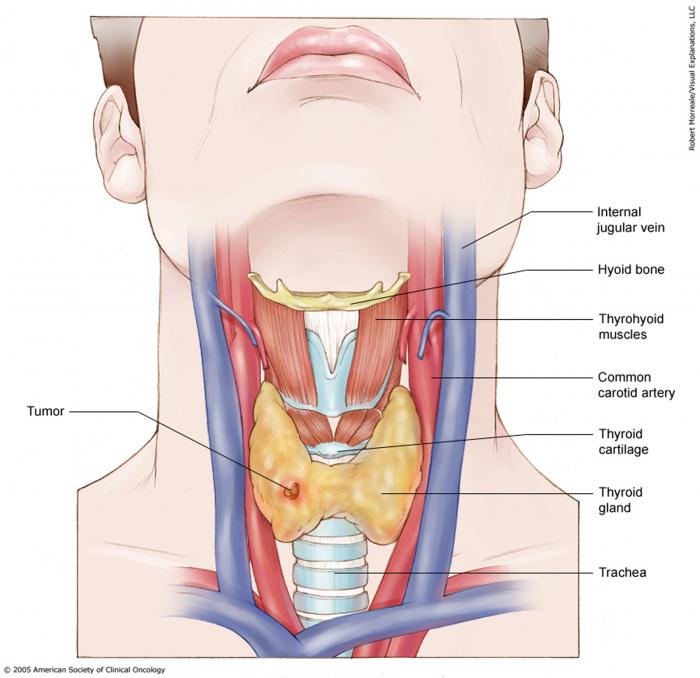
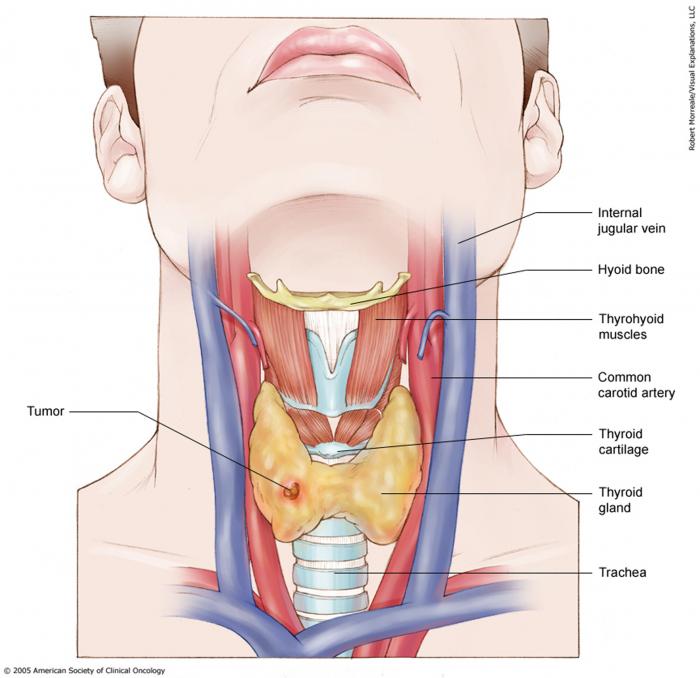
T1: The tumor is 2 centimeters (cm) or smaller and limited to the thyroid.
T1a: The tumor is 1 cm or smaller.
T1b: The tumor is larger than 1 cm but less than 2 cm.
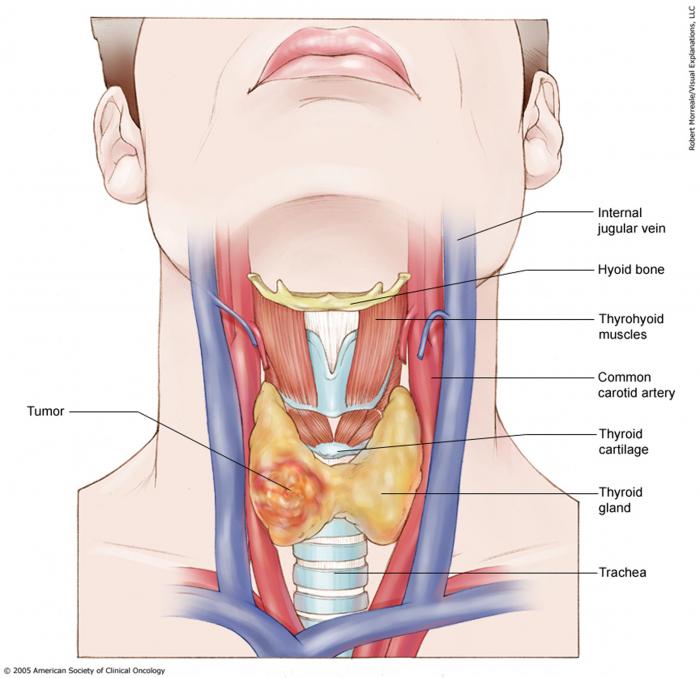
T2: The tumor is larger than 2 cm but smaller than 4 cm and is limited to the thyroid.
T3: The tumor is larger than 4 cm, but the tumor does not extend beyond the thyroid gland.
T4: The tumor is any size and has extended beyond the thyroid.
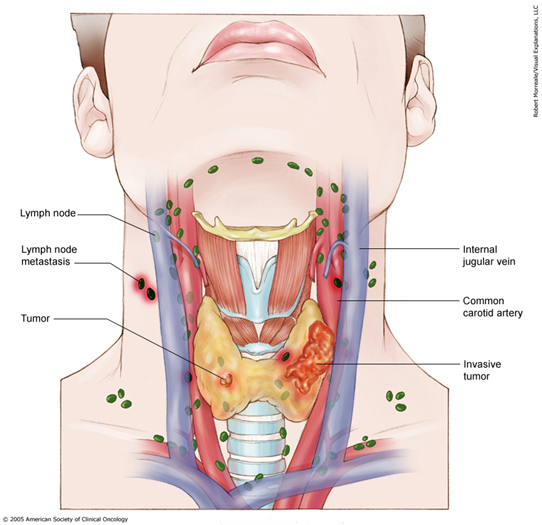
T4a: The tumor has spread beyond the thyroid to nearby soft tissues, the larynx, trachea, esophagus, or recurrent laryngeal nerve.
T4b: The tumor has spread beyond the regions in T4a (above).
Node (N)
The “N” in the TNM staging system stands for lymph nodes. Careful evaluation of lymph nodes is an important part of staging thyroid cancer. There are many regional lymph nodes located in the head and neck area. Lymph nodes in other parts of the body are called distant lymph nodes.
NX: The regional lymph nodes cannot be evaluated.
N0 (N zero): There is no evidence of cancer in the regional lymph nodes.
N1: Cancer has spread to the lymph nodes.
N1a: Cancer has spread to the lymph nodes around the thyroid (called the central compartment; the pretracheal, paratracheal, and prelaryngeal lymph nodes).
N1b: Cancer has spread beyond the central compartment, including unilateral cervical (lymph nodes on 1 side of the neck), bilateral cervical (lymph nodes on both sides of the neck), contralateral cervical (the opposite side of the tumor), or mediastinal (the chest) lymph nodes.
Metastasis (M)
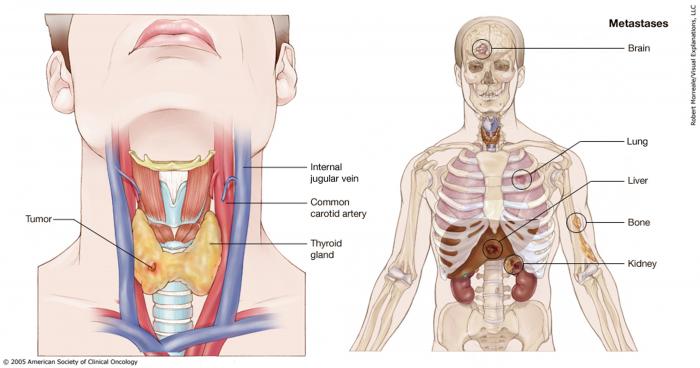
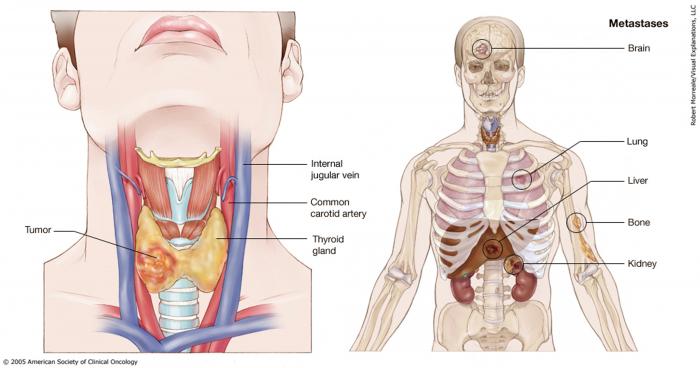
The “M” in the TNM system describes whether cancer has spread to other parts of the body, called metastasis.
MX: Distant metastasis cannot be evaluated.
M0 (M zero): Cancer has not spread to other parts of the body.
M1: Cancer has spread to other parts of the body.
Stage groups for thyroid cancer
Doctors assign the stage of the cancer by combining the T, N, and M classifications (see above) to say what stage the cancer is.
For thyroid cancer, this staging system differs by tumor type. For papillary or follicular thyroid cancer, staging also depends on the age of the patient.
Stage groups for papillary or follicular thyroid cancer in a person younger than 55
Stage I: This stage describes a tumor (any T) with or without spread to lymph nodes (any N) and no distant metastasis (M0).
Stage II: This stage describes a tumor (any T) with any metastasis (M1) regardless of whether it has spread to the lymph nodes (any N).
Stage groups for papillary or follicular thyroid cancer in a person 55 and older
Stage I: This stage describes any small tumor (T1) with no spread to lymph nodes (N0) and no metastasis (M0).
Stage II: This stage describes a larger, noninvasive tumor (T2) with no spread to lymph nodes (N0) and no metastasis (M0).
Stage III: This stage describes a tumor larger than 4 cm but still contained in the thyroid (T3) with no spread to lymph nodes (N0) and no metastasis (M0). Or, any localized tumor (T1, T2, or T3) with spread to the central compartment of lymph nodes (N1a) but no distant spread (M0).
Stage IVA: This stage describes a tumor that has spread to nearby structures (T4a), regardless of whether it has spread to the lymph nodes (any N), but it has not spread to distant places (M0). Or, this describes a localized tumor (T1, T2, or T3) with lymph node spread beyond the central compartment (N1b) but no distant spread (M0).
Stage IVB: This stage describes a tumor that has spread beyond nearby structures (T4b), regardless of spread to lymph nodes (any N), but no distant spread (M0).
Stage IVC: This stage describes all tumors (any T, any N) when there is evidence of metastasis (M1).
Stage groups for medullary thyroid cancer
Stage I: This stage describes a small tumor (T1) with no spread to lymph nodes (N0) and no distant metastasis (M0).

Stage II: This stage describes a larger localized tumor (T2 or T3) with no spread to lymph nodes (N0) and no metastasis (M0).

Stage III: This stage describes any localized tumor (T1, T2, or T3) that has spread to the central compartment of lymph nodes (N1a) but has not metastasized (M0).
Stage IVA: This stage describes a tumor that has spread to nearby structures (T4a), regardless of whether it has spread to the lymph nodes (any N), but it has not spread to distant places (M0). Or, this describes a localized tumor (T1, T2, or T3) with lymph node spread beyond the central compartment (N1b) but no distant spread (M0).
Stage IVB: This stage describes a tumor that has spread beyond nearby structures (T4b), regardless of spread to lymph nodes (any N), but no distant spread (M0).
Stage IVC: This stage is used when there is evidence of metastasis (any T, any N, M1).

Stage groups for anaplastic thyroid cancer
Stage IV: All anaplastic thyroid tumors are classified as stage IV, regardless of tumor size, location, or metastasis.
Stage IVA: This stage describes an anaplastic tumor that has spread to nearby structures (T4a), regardless of whether it has spread to the lymph nodes (any N), but it has not spread to distant places (M0).
Stage IVB: This stage describes an anaplastic tumor that has spread beyond nearby structures (T4b), regardless of spread to lymph nodes (any N), but no distant spread (M0).
Stage IVC: This stage is used when there is evidence of metastasis (any T, any N, M1).
Recurrent: Recurrent cancer is cancer that has come back after treatment. If the cancer does return, there will be another round of tests to learn about the extent of the recurrence. These tests and scans are often similar to those done at the time of the original diagnosis.
Used with permission of the American College of Surgeons, Chicago, Illinois. The original and primary source for this information is the AJCC Cancer Staging Manual, Eighth Edition (2017), published by Springer International Publishing.
Information about the cancer’s stage will help the doctor recommend a specific treatment plan. The next section in this guide is Types of Treatment. Use the menu to choose another section to continue reading this guide.