
ON THIS PAGE: You will find some basic information about this disease and the parts of the body it may affect. This is the first page of Cancer.Net’s Guide to Wilms Tumor - Childhood. Use the menu to see other pages. Think of that menu as a roadmap for this entire guide.
About the kidneys
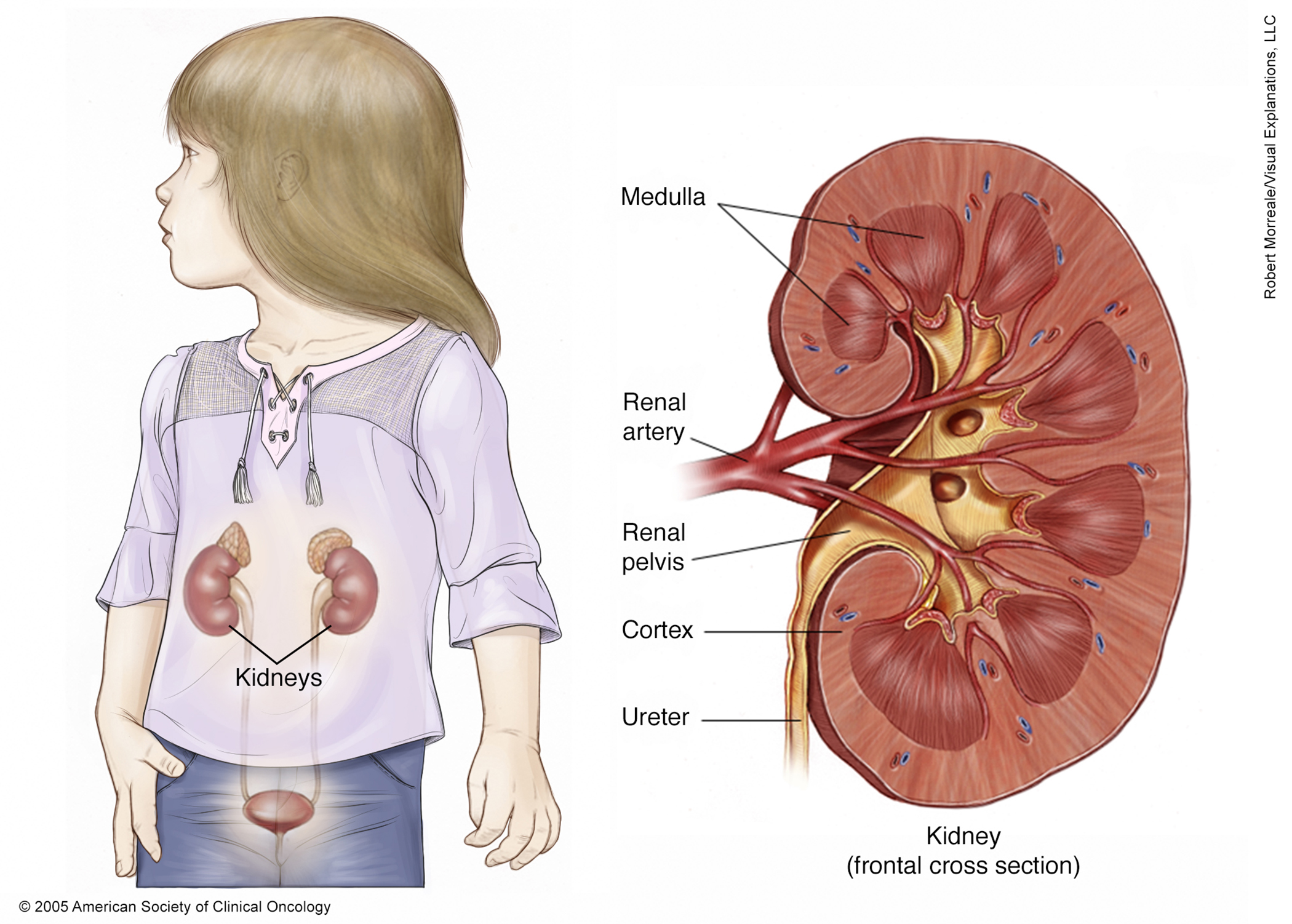
Every person has 2 kidneys, which are located above the waist on both sides of the spine. These reddish-brown, bean-shaped organs are closer to the back of the body than to the front. The kidneys filter blood to remove impurities, excess minerals and salts, and extra water. They also produce hormones that help control blood pressure, red blood cell production, and other bodily functions.
As the kidneys develop in an unborn baby, some of the early cells will become glomeruli, which are balls of blood vessels that filter water, salt, and waste out of the blood. Others will become nephrons, which are the tubes through which the water, salt, and waste pass.
About Wilms tumor
If the early cells of the kidney do not develop into glomeruli or nephrons, clusters of the immature cells may form in the kidneys when the baby is born. Usually, these cells mature by the time a child is 3 or 4 years old, but some may grow out of control, forming a mass of immature cells. This mass is called a Wilms tumor. It can also be called a nephroblastoma.
A Wilms tumor is always cancerous. It is the most common type of kidney cancer diagnosed in children. A cancerous tumor is malignant, meaning it can grow and spread to other parts of the body. However, a Wilms tumor is very different from adult kidney cancer.
A Wilms tumor usually occurs in only 1 kidney, called unilateral. However, it can also develop in both kidneys, called bilateral. Rarely, a Wilms tumor develops in 1 kidney first and then the other.
A Wilms tumor is often found only after it has grown to a size of about 8 ounces, which is about 4 times the weight of a healthy 3-year-old child’s kidney. About 1 out of 4 children with a Wilms tumor have evidence that the tumor has spread either to the lung or liver when it is first diagnosed.
Looking for More of an Introduction?
If you would like more of an introduction, explore these related items.
-
Find a Cancer Doctor. Search for a cancer specialist in your local area using this free database of doctors from the American Society of Clinical Oncology (ASCO).
-
Cancer Terms. Learn what medical phrases and terms used in cancer care and treatment mean.
The next section in this guide is Statistics. It helps explain the number of children who are diagnosed with a Wilms tumor and general survival rates. Use the menu to choose a different section to read in this guide.