
ON THIS PAGE: You will find some basic information about childhood non-Hodgkin lymphoma and the parts of the body it may affect. This is the first page of Cancer.Net’s Guide to Childhood Non-Hodgkin Lymphoma. Use the menu to see other pages. Think of that menu as a roadmap for this entire guide.
About the lymphatic system
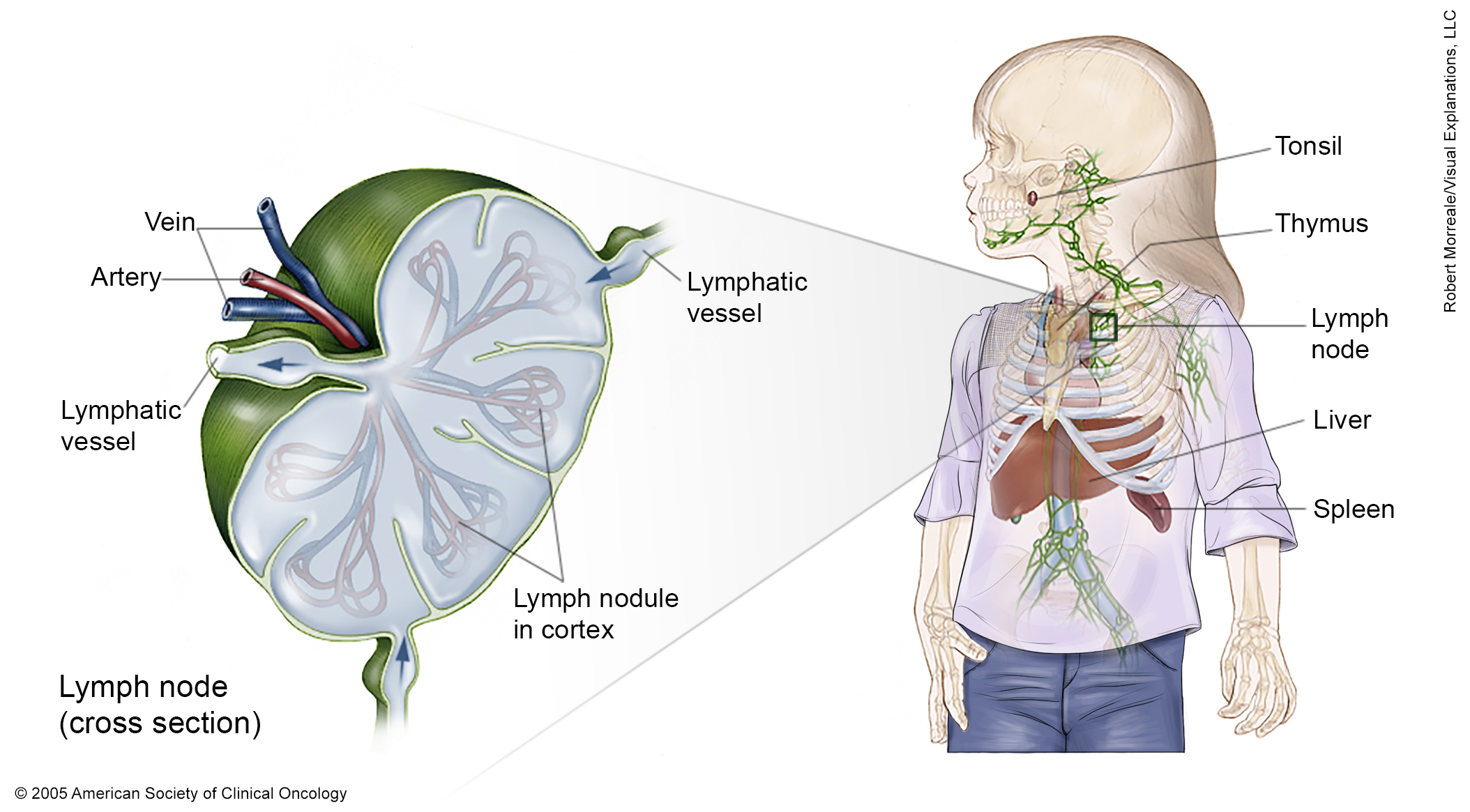
The lymphatic system is made up of thin tubes that branch out to all parts of the body. The lymph system carries lymph, a colorless fluid containing lymphocytes. Lymphocytes are a type of white blood cell that are part of our immune system and help fight germs in the body. B-lymphocytes, also called B cells, make antibodies to fight bacteria. T-lymphocytes, also called T cells, kill viruses and foreign cells and trigger the B cells to make antibodies.
Groups of small, bean-shaped organs called lymph nodes are located throughout the body at different sites in the lymphatic system. The largest areas of lymph nodes are found in the neck, chest, underarms, abdomen, pelvis and groin.
Other parts of the lymphatic system include the tonsils, thymus, spleen, and bone marrow.
-
The tonsils are located in the throat.
-
The thymus is an organ under the breastbone.
-
The spleen, which makes lymphocytes and filters the blood, is located in the left upper abdomen.
-
The bone marrow is the spongy red tissue inside bones that makes white blood cells, which are cells that fight infection. The bone marrow also makes red blood cells and platelets. Red blood cells carry oxygen throughout the body. Platelets help the blood to clot.
About non-Hodgkin lymphoma
Non-Hodgkin lymphoma (NHL) is a term that refers to a group of several, very different types of lymphoma. Lymphoma is a cancer of the lymphatic system. Lymphoma usually begins when healthy cells in the lymphatic system change and grow out of control, which may form a tumor. Occasionally, lymphoma can also begin outside the lymph node system, called extranodal, especially in children.
Because lymph tissue is found in so many parts of the body, NHL can start almost anywhere and can spread to almost any organ in the body. It most often begins in the lymph nodes, liver, or spleen but can also involve the stomach, intestines, skin, thyroid gland, or any other part of the body.
This section covers NHL in children. Learn more about adult NHL.
Types of NHL in children
There are 3 major categories of NHL in children. The category is identified by how the cells look under a microscope.
-
Burkitt lymphoma. This type of B-cell lymphoma commonly affects the bone marrow and central nervous system (brain and spinal cord). Burkitt lymphoma is one of the fastest growing types of cancer. It most often develops in the abdomen and may spread to other organs, including the brain. Burkitt lymphoma accounts for about 40% of NHL in children in the United States.
-
Large cell lymphoma (LCL). LCL accounts for about 25% of childhood NHL. LCL may develop in the throat, abdomen, lymph tissue of the neck, or near the thymus. LCL is further classified into subtypes. The most common subtypes of LCL are large B-cell lymphoma (15%), which develops from B cells, and anaplastic large cell lymphoma (ALCL; 10%), which usually develops from T cells but can in rare situations arise from B cells.
-
Lymphoblastic lymphoma (LBL). LBL accounts for about 30% of all childhood NHL. It most often develops in lymph nodes in the chest area (mediastinum) behind the breastbone (near the thymus gland) and can spread to the surface of the brain, the bone marrow, other lymph nodes, and the tissue covering the heart and lungs.
Looking for More of an Introduction?
If you would like more of an introduction, explore this related item. Please note that this link will take you to other sections on Cancer.Net:
-
Cancer.Net En Español: Read about childhood NHL in Spanish. Infórmase sobre el linfoma no Hodgkin en niños en español.
-
Cancer.Net Patient Education Video: View a short video led by an ASCO expert in lymphoma that provides basic information and areas of research.
-
Find a Cancer Doctor. Search for a cancer specialist in your local area using this free database of doctors from the American Society of Clinical Oncology (ASCO).
-
Cancer Terms. Learn what medical phrases and terms used in cancer care and treatment mean.
The next section in this guide is Statistics. It helps explain the number of children and teens who are diagnosed with childhood NHL and general survival rates. Use the menu to choose a different section to read in this guide.